
Edmonton Neighbourhood Profile
Virginia Park
Virginia Park is an Edmonton neighbourhood of about 206 homes — 88.8% houses and 11.2% condos, most homes built around 1949. The typical (median) house is assessed at $402,500, 15% below the citywide median (204th of 282 neighbourhoods); condos around $86,500. Across its established houses — largely the same properties over time — the median assessed value changed +28% from 2012 to 2026. 43% of homes are owner-occupied, median household income is $38,400, and 3 public schools are designated for it. Figures throughout are City assessed values — directional and comparative, not exact sale prices ("typical" means the median).
Total homes
206
88.8% houses · 11.2% condos
Typical house
$402,500
15% below citywide · 204th of 282
Typical condo
$86,500
58% below citywide
House $/sq ft
$362
$3,897/m² · 14% above citywide
Typical lot
5,038 ft²
468 m² · 4% below citywide
Typical age
1949
median house build year
Part of North Central — see the area profile for Virginia Park's wider market context.
Where it is
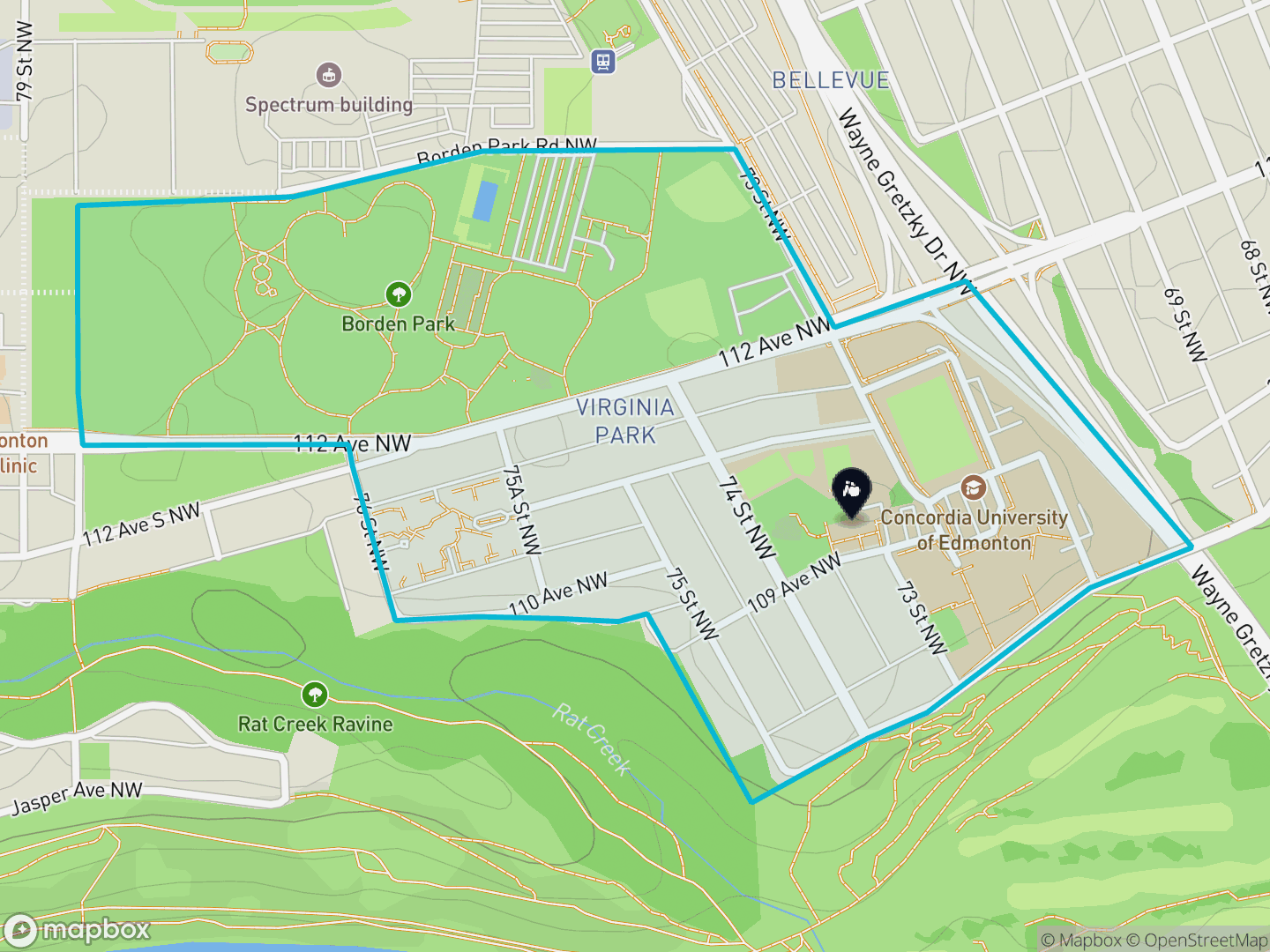
At a glance.Virginia Park's location and boundary, with schools marked — green areas are parks and open space.
Stay in the loop
Get the Edmonton market update
My monthly read — what's selling, where prices are headed, and what it means.
The homes
What's built here — the housing stock, its age, and the condo & rental supply.
What's here
Mostly houses. 88.8% houses (freehold) · 11.2% condos (condominium-titled).
Building types in detail
Bedrooms — homes here by bedroom count:
6% of homes needed major repairs in 2021, as assessed by their own residents.
Building-type, bedroom and condition figures from the 2021 federal census.
When it was built
Most homes here were built before 1960. The median build year is 1949.
Full age breakdown
Condos & multi-family
1 condo development here — about 23 condo dwellings, plus 6 purpose-built rental / multi-family buildings.
How condos & rentals are counted
1 condo development — about 23 condo dwellings in total. Separately-titled parking and storage stalls aren't counted as homes.
6 rental / multi-family buildings, typically built around 1983 — 3 small (under $1M), 3 mid ($1–10M). Purpose-built rentals (assessed as a single parcel each), separate from the owned homes counted above. Unit counts aren't in the open data.
Living here
The people and the day-to-day — who lives here, and the schools, shops, parks and transit around them.
Who lives here
An even owner / renter mix. Median household income $38,400.
Resident snapshot from the 2021 federal census.
Median household income
$38,400
33% earn $100k+
Homeowners
43%
57% rent
Bachelor's degree or higher
27%
of residents 15+
Commute to work
92%
drive · 0% transit · 0% walk/bike
Median age 55.2; 63% of households are people living alone; 38% lived at a different address five years earlier.
Residents by age
Median age 55.2.
Household income spread
6% of households reported $200k or more; 49% under $50k.
Government transfers made up 23% of residents' 2020 income (including 3.9% pandemic supports — 2020 was a COVID income year); 20% of residents were below the low-income measure (LIM-AT).
Household total income, 2020, from the 2021 federal census (income shares and low-income prevalence as reported). Statistics Canada rounds and suppresses small counts, so shares may not sum exactly to 100.
Households & families
Average household size 1.8; families with kids at home average 1.5 children.
What residents do for work
Occupation groups (share of the labour force):
Industries residents work in (top 10; the rest combined):
Unemployment rate in the census reference week (May 2021): 16.3% — a pandemic-period snapshot.
How long people stay
12% of residents had moved within the previous year; 38% lived at a different address five years earlier.
Counts every change of address — moves within Virginia Park, into it, owners and renters alike.
Immigration & citizenship
89% of residents were born in Canada; 12% are immigrants.
When the area's immigrants arrived:
Immigrant status and period of immigration, the 2021 federal census. Counts everyone in private households.
Ethnocultural origins
The origins residents most often reported. People can report more than one, so these overlap and don't add up to 100%.
Ethnic or cultural origin, the 2021 federal census — share of residents reporting each (multiple responses allowed).
Population groups
11% of residents identified as a visible minority; 89% did not.
Separately, 15% of residents identify as Indigenous.
Statistics Canada defines a "visible minority" as "persons, other than Aboriginal peoples, who are non-Caucasian in race or non-white in colour" (the federal Employment Equity Act's wording). That's why Indigenous residents are shown separately above, and why there's no "white" category here: the residents counted as "not a visible minority" are predominantly those who identify as white, plus the Indigenous residents shown above. Shares are of all residents, the 2021 federal census.
Religion
Religion, the 2021 federal census. The census asks this once a decade (most recently 2021); major groups shown.
Housing costs & affordability
A household earning the local median income would put about 53% of it toward typical owner shelter costs here — or 23% toward the typical rent.
Typical owner shelter cost
$1,680/mo
57.1% of owners hold a mortgage
Typical rent
$735/mo
median tenant shelter cost
Affordability in detail
Households spending 30% or more of their own income on their own shelter — the standard affordability-stress measure: 0% of owner households · 67.6% of renter households. (Different from the headline above, which compares the median cost against the median income — a typical-household what-if, not a count of stretched households.)
In core housing need (unaffordable, unsuitable or inadequate, with no affordable local alternative): 0% of owners · 52.8% of renters.
Owners' own estimate of their home's value (2021): $360,000 median — self-reported, so it can differ from the assessed medians above.
Owner costs reflect current owners — including long-time, mortgage-free ones — not the cost to buy in today. The income-share figures compare 2020 median household income with shelter costs reported in 2021.
Schools
3 designated public schools. Edmonton Public catchment for Virginia Park: Highlands, Virginia Park and Eastglen.
All schools, levels & catchment notes
Designated public schools (Edmonton Public Schools catchment for Virginia Park):
- Elementary / Junior HighHighlandsK to Gr 9
- ElementaryVirginia ParkK to Gr 6
- Senior HighEastglenGr 10-12
Catchments are set by the school board and can change — and the City's published catchment data can lag new schools and boundary updates — so confirm the current designated school with Edmonton Public Schools before relying on it.
Schools located in Virginia Park:
- PublicVirginia ParkElementary
Independent / private schools aren't in the City's open data, so they aren't listed here. School-quality ratings are published separately by the Fraser Institute (not affiliated with this site).
Shopping & amenities
About 6 businesses in Virginia Park, employing roughly 390 people.
Business mix & how this is counted
From the City's business census (2025 survey).
The mix of what's here, from currently-licensed businesses:
Counts come from City of Edmonton business licences and the City's business census — a licence means a business is registered at an address here, not a guarantee it's open today , and includes home-based businesses (about 41% of licences here). Landlord rental licences are excluded, and a listing isn't an endorsement.
Parks & green space
2 parks (22 hectares) and 4 playgrounds in Virginia Park — includes a city park.
Parks
2
22 hectares total
Playgrounds
4
3 wheelchair-accessible
Green-space types & notes
Types of green space:
- City park1
- School & community park1
Counts come from the City of Edmonton's parks and playgrounds open data. A park is attributed to the neighbourhood its centre point falls in, so a large park or greenway that spans several areas is counted once — treat boundaries as approximate. Trail corridors appear here as greenways; off-street bike routes aren't included.
Transit & connectivity
No LRT line in Virginia Park today. The nearest station is Coliseum (Capital Line), about 1.2 km away (straight-line). The neighbourhood is served by 2 bus routes.
Looking ahead, the nearest future stop is MacEwan Arts / 112 Street on the Valley Line West, about 4.5 km from the centre — under construction, targeted to open later this decade. Timelines can slip, and a nearby line doesn't imply any change in property values.
Nearest LRT
1.2 km
to Coliseum
Bus routes
2
serving the area
Future LRT
4.5 km
MacEwan Arts / 112 Street · under construction
Bus routes & notes
2 bus routes serve Virginia Park: 101 and 111. They run from 8 boardable stops inside the neighbourhood.
No route here meets the frequent-service bar (≈ 15-minute weekday headway).
Bus routes and frequency come from the City's ETS GTFS schedule — the routes whose trips call at stops inside Virginia Park, with “frequent” meaning at least 100 weekday trips through the neighbourhood (about a bus every 15 minutes or better, counting both directions). Distances are straight-line (“as the crow flies”) from the neighbourhood centre — the actual walking or driving route is longer. Future stations are under construction; their locations and timelines come from City of Edmonton project pages and can change. Day-to-day commute mode (drive / transit / walk) is shown under “Who lives here.” Source: City of Edmonton LRT & ETS (GTFS) Open Data.
The market
Assessed value over time, and recent building activity.
Assessed value over time
Median assessed value changed +28% from 2012 to 2026.
That tracks Virginia Park's houses — largely the same homes throughout — so it's a real value change, not a shifting mix.
Building activity
Since 2015: 147 building permits, a net loss of about 1 home, and 5 secondary-suite permits.
Permits year by year
Permits count every new home built — including purpose-built rental apartments and mixed-use buildings — so this can run well above the "total homes" figure above, which counts only individually-owned houses and condos.
Source
City of Edmonton Open Data — current-year property assessment & information, historical assessment roll (value trend), building permits; Statistics Canada 2021 Census of Population (City of Edmonton neighbourhood tabulation). Contains information licensed under the Open Government Licence – City of Edmonton.
About these figures. They use the City of Edmonton's 2026 assessment roll — its mass-appraisal estimate of market value as of July 1, 2025, informed by that year's sales but applied across the whole roll at once. That makes it a reliable directional and comparative signal (ideal for "how does this neighbourhood compare"), but not the exact price a specific home would sell for today — for that you need a comparative market analysis. Resident demographics and housing-cost figures (income and its distribution, age, education, commute, tenure, household types, shelter costs, occupations and industries, mobility) and the building-type, bedroom and condition mix are from the 2021 federal census — the most recent neighbourhood-level vintage; the City notes it fell during the pandemic, so treat these figures as directional. Census figures are adapted from Statistics Canada, 2021 Census of Population; this does not constitute an endorsement by Statistics Canada. Trevor Tardif is a licensed REALTOR® with REAL Broker AB Ltd, Edmonton, Alberta. Content on this site does not constitute financial or investment advice.
Stay in the loop
Watching Virginia Park? Get the bigger picture.
Virginia Park is one neighbourhood — but the forces that move its prices play out city-wide. That's what my market read tracks.
What's your Virginia Park home actually worth?
Assessed value is a starting point, not a sale price. I'll run a real comparative market analysis on your specific home and walk you through the number.